2022 marks Satisloh's 100th Anniversary. While we are incredibly proud of this achievement, we are also humbled by the fact that few companies reach this major milestone. We know we never could have made it without the help and support of countless people along the way. We owe our longevity to the customers, suppliers and employees we've worked with over the years.
Celebrate with us our first 100 years during trade shows & events around the globe.
March 17, 1922, Wilhelm Loh went into business for himself, founding a mechanical workshop. The founding period of the Wilhelm Loh company was marked by the consequences of the first World War, a time when economic depression and hunger prevailed in many parts of Germany. It is therefore not surprising that his small company initially engaged in manufacturing machines for canning jars. In addition, special wheel lathes were used to produce cast-iron lapping tools for numerous local optical factories. The production of optical lenses at that time by lapping with emery of different grain size required for each lens radius to be produced whole sets of special lapping tools made of gray cast iron (then called "grinding shells") and corresponding polishing tools (then called polishing shells). Each of these tools required a complementary shaped grinding or pressure tool in addition to maintaining the exact shape of the spherical surface. Later, Loh also manufactured spindles for optical machines.
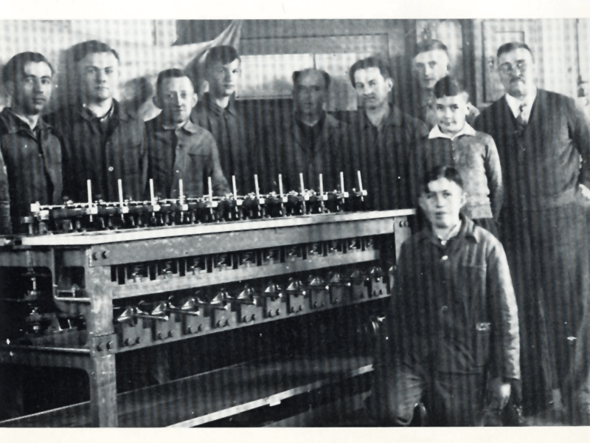
Due to the initial success and the increasing demand for micro-lenses and prisms for the local microscope manufacturers, the company moved into a new factory building in Friedenstraße only three years after its founding. Here, multi-spindle lever machines for lapping and polishing micro-lenses, as well as for machining plano surfaces on prisms were initially manufactured. The photo shows Wilhelm Loh and his employees with a 12-spindle lever machine.
The optical machines initially produced at Loh focused mainly on processing microscope optics, this spectrum was greatly expanded with the popularity of 35 mm photography (Leica), binoculars and telescopes. The optics for these products required powerful, larger lever machines with which optics of larger diameters could also be manufactured individually and cemented onto supporting bodies. Loh initially developed these machines for the domestic optical industry, with which it worked closely on machine development.
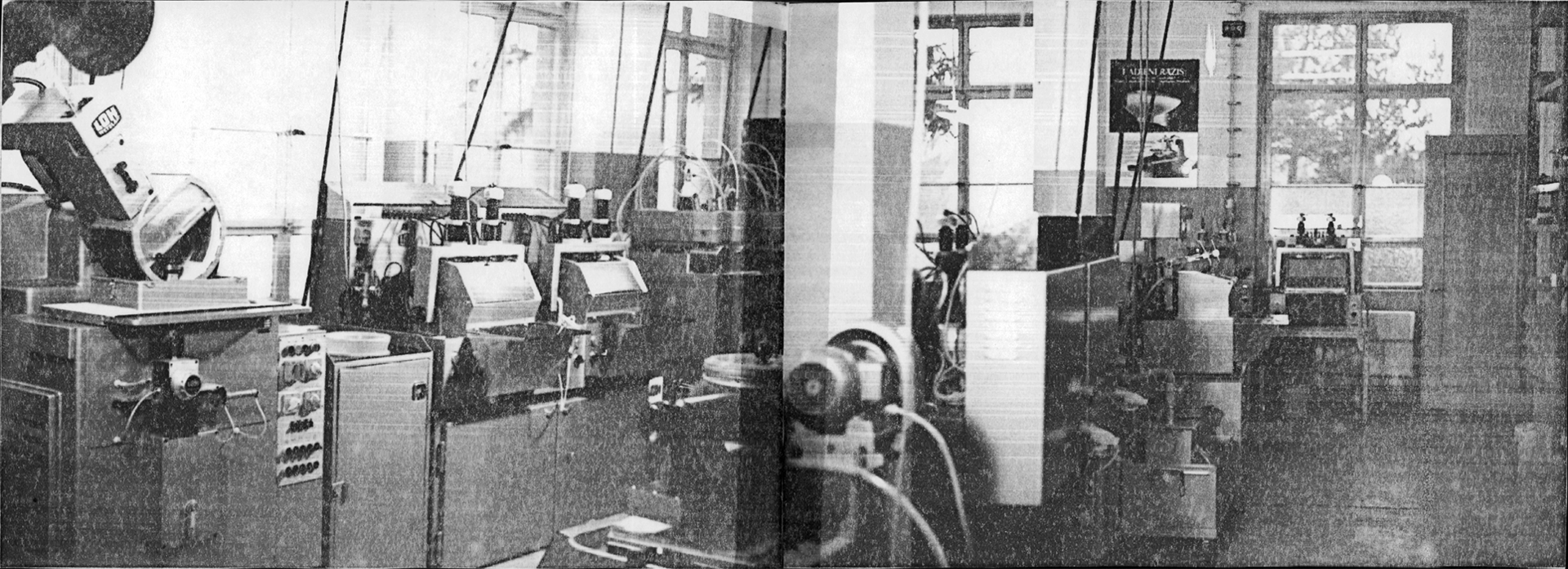
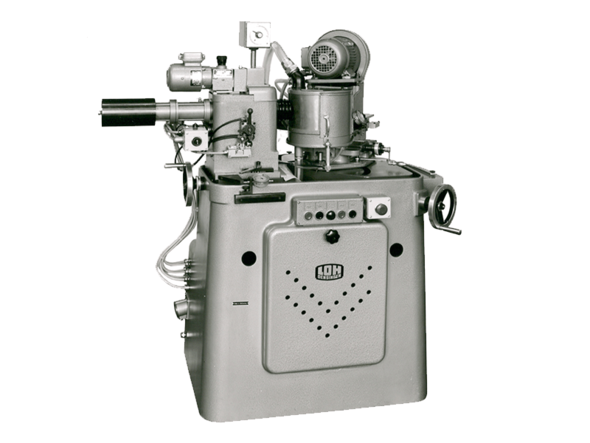
The first diamond-tipped grinding tools were developed during World War II. The commercial production of sintered, metal-bonded diamond cup grinding wheels revolutionized optical production at the beginning of the 1950s. Lapping with emery and a large number of "grinding bowls" specially adapted to the emery grain size were no longer necessary. Diamond cup grinding wheels made it possible, for the first time, to grind spherical lenses of any radius, by positioning them appropriately in the machine. Angular and lateral tool spindle adjustment of the "Radius Milling Machine" RF1 determined the lens radius. The axial infeed of the workpiece spindle produces the center thickness of the ground lens. The infeed speed was force-controlled by a pre-loadable spring via a sequence curve. The lens itself was held in a collet on a rotating workpiece spindle during the grinding process. Alternatively, it was also possible to grind several lenses cemented onto support bodies. However, the grinding quality of the machined lens required an additional lapping or fine grinding operation before polishing. In subsequent years, versions of the RF1 with automatic workpiece change were introduced. The larger RF 2 worked on the same principle and was designed for grinding large single lenses and multiple machining on support bodies.
After the Second World War, there was an increased demand for eyeglass lenses in West Germany. During this time, the Loh company was not only involved in manufacturing machines for processing eyeglass lenses, but also producing eyeglass lenses. This field of activity was obvious, especially since the development of new machines was always accompanied by the development of processing technology.
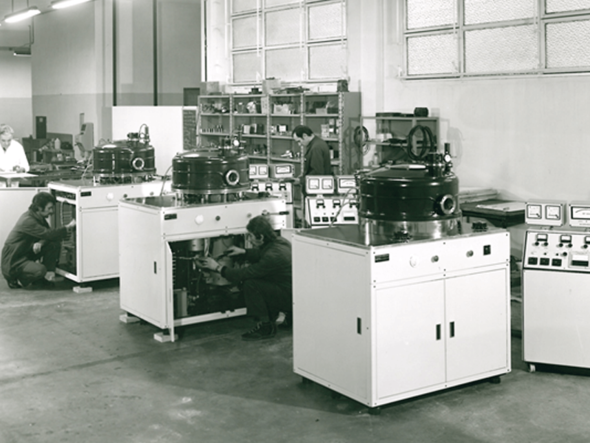
Satis Vacuum is founded by Delio Ciparisso. Coating machine production for the ophthalmic industry starts in the basement of an apartment house in Italy, with management and administration in Zurich, Switzerland.